The Shadow We Refuse to Meet
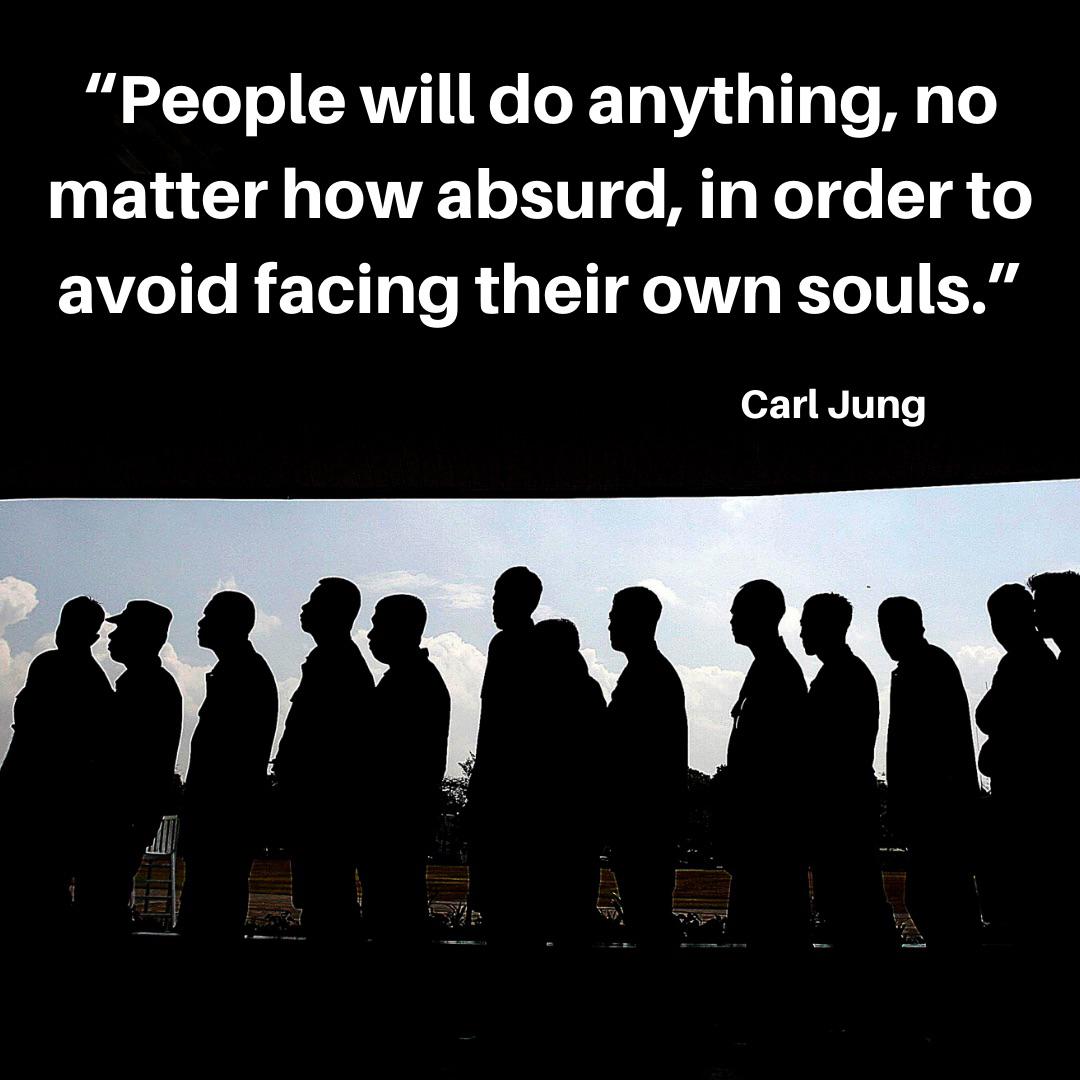
“People will do anything, no matter how absurd, to avoid facing their own souls.” — Carl Jung
HAVE A LISTEN BEFORE YOU READ BELOW
Perhaps one of the most tragic observations ever made about humanity is not that we suffer, but that we spend our lives inventing elaborate ways to avoid understanding why.
Carl Jung understood something that many of us still resist today: the greatest prison is not the world around us—it is the one within us.
We exhaust ourselves chasing new careers, new relationships, new identities, new possessions, new beliefs, new distractions and even new versions of spirituality, hoping that somewhere beyond the horizon exists the answer to a discomfort we cannot quite name. Yet the one journey we consistently postpone is the shortest one imaginable: the journey inward.
Ironically, the very thing we fear is the place we already live.
Many people speak as though darkness is something outside themselves—as though anger belongs to someone else, bitterness belongs to someone else, envy belongs to someone else, resentment belongs to someone else. They fear acknowledging these emotions because they believe doing so somehow makes them bad people.
The opposite is often true.
The emotions we refuse to acknowledge are usually the ones quietly directing our lives from behind the curtain.
This is the paradox of the shadow
People often imagine their shadow as a terrifying hidden monster lurking beneath consciousness. In reality, the shadow is frequently much less dramatic and far more ordinary. It is the forgotten grief. The unspoken shame. The childhood wound. The jealousy we disguise as criticism. The fear masquerading as control. The loneliness hidden beneath perfectionism. The insecurity concealed by arrogance. The pain dressed as constant busyness.
The shadow rarely announces itself.
It simply whispers through our behaviours.
We insist we keep attracting the wrong people. We complain that life is unfair. We repeat the same conflicts with different faces. We chase happiness but somehow never arrive.
We tell ourselves that everyone else is the problem while wondering why the scenery never changes.
The external world begins to resemble an endless loop.
From many philosophical and spiritual perspectives, it can feel as though we become magnetised toward experiences that resonate with our unresolved inner world. Whether one understands this through psychology, behavioural conditioning, spirituality or simply recurring life patterns, the effect can feel remarkably similar: what remains unconscious continues to influence the direction of our lives.
We become residents of emotional landscapes we insist we never chose.
This is where the paradox deepens
Many people spend their lives desperately trying to escape darkness while unknowingly living inside it.
Not because darkness has consumed them, but because it has never been acknowledged.
We fear looking at our shadow because we imagine it will destroy us. Yet avoiding it often does precisely that. The shadow does not become dangerous because it exists.
It becomes dangerous because it remains invisible.
Anything hidden gains influence.
Anything unconscious gains control.
Anything denied seeks expression.
The emotions we suppress do not disappear; they simply find subtler ways to speak. They emerge through anxiety, projection, resentment, self-sabotage, addiction to distraction, chronic dissatisfaction, fractured relationships or the quiet belief that life is happening to us rather than through us.
Perhaps this is why genuine healing feels so uncomfortable.
Healing is not becoming someone new. It is becoming honest.
It is sitting beside the frightened parts of ourselves without demanding they disappear.
It is recognising that courage is not the absence of darkness but the willingness to carry a light into it.
The soul does not ask us to become perfect. It asks us to become whole.
Wholeness has never meant choosing light over dark. It means recognising that both belong within the same human story.
Every tree stretches toward the sun because its roots first disappear into darkness.
Nature has understood this long before we did.
Growth does not happen despite the dark.
It happens because of it.
Perhaps our greatest fear has never been the shadow itself.
Perhaps our greatest fear is discovering that the person we have spent our lives running from has quietly been waiting to set us free.
The shadow is not your enemy. It is your unfinished conversation with yourself.
And maybe Carl Jung’s words are not a criticism of humanity at all.
Maybe they are an invitation. An invitation to stop searching for another escape route.
To stop blaming another person. To stop waiting for another timeline, another opportunity, another miracle.
And instead, to have the courage to meet the one person you have unknowingly avoided all along.
Your own soul.
What are your feelings about this? hHow does this post make you FEEL? Uncomfortable? Excited? Scared? Curious? Did you laugh at this and THINK WTF is this person talking about, what a load of shit? or did it make you pause for a moment and question, how do I feel about certain things? How can I integrate my feelings more before I think about them, analyse them, interpret them through my limiting mind?
IN THE NEXT POST WE ARE GOING TO TALK ABOUT FREEDOM AND THE CONSEQUENCES OF SEEKING ULTIMATE FREEDOM PLUS SOME PRACTICAL EXERCISES TO HELP YOU PRACTICE UNDERSTANDING YOUR EMOTIONS BEFORE YOUR THOUGHTS GET IN THE WAY….
See you there x


2 thoughts on “The Twilight Zone”