The Twilight Zone

The Shadow We Refuse to Meet

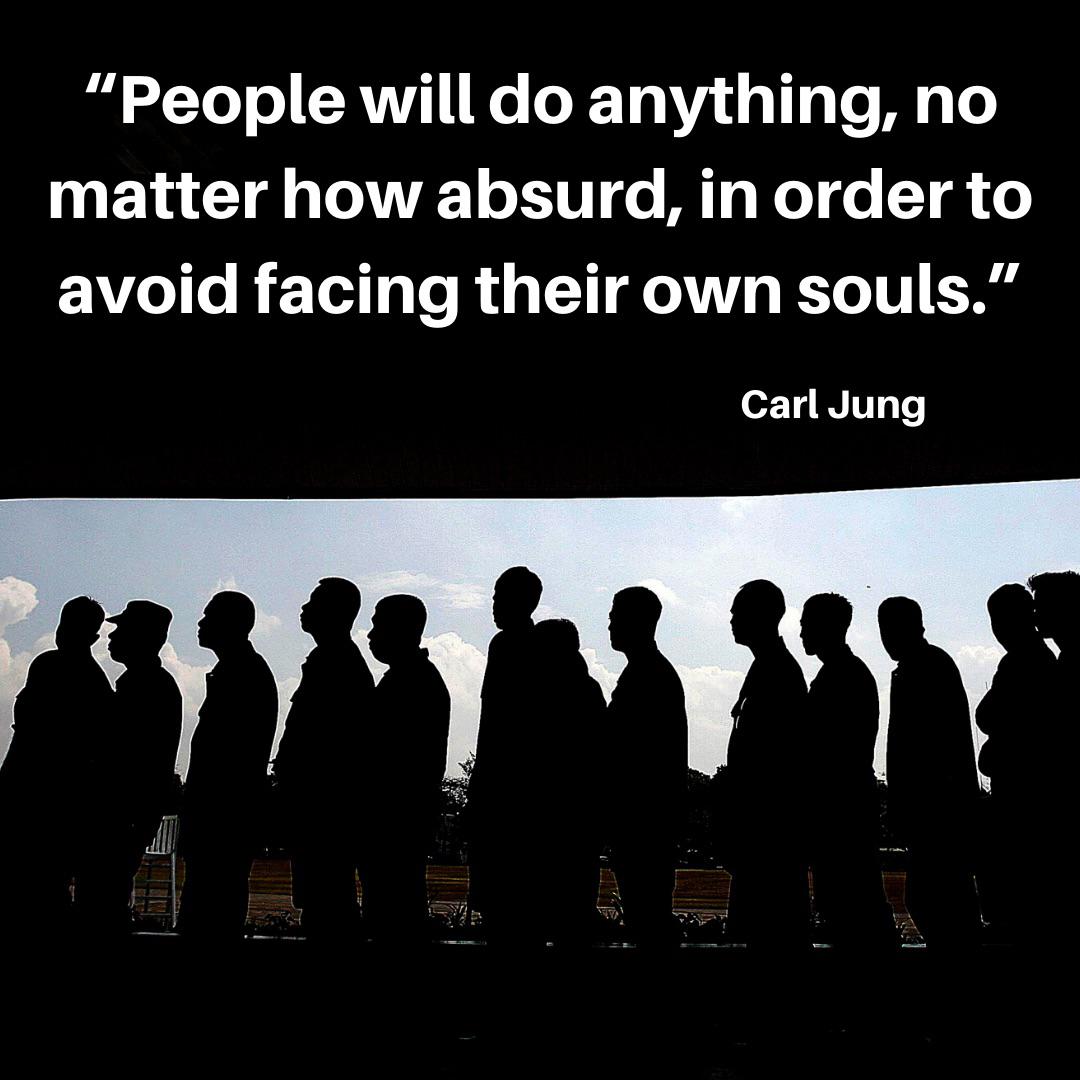
“People will do anything, no matter how absurd, to avoid facing their own souls.” — Carl Jung

HAVE A LISTEN BEFORE YOU READ BELOW

Perhaps one of the most tragic observations ever made about humanity is not that we suffer, but that we spend our lives inventing elaborate ways to avoid understanding why.

Carl Jung understood something that many of us still resist today: the greatest prison is not the world around us—it is the one within us.

We exhaust ourselves chasing new careers, new relationships, new identities, new possessions, new beliefs, new distractions and even new versions of spirituality, hoping that somewhere beyond the horizon exists the answer to a discomfort we cannot quite name. Yet the one journey we consistently postpone is the shortest one imaginable: the journey inward.

Ironically, the very thing we fear is the place we already live.

Many people speak as though darkness is something outside themselves—as though anger belongs to someone else, bitterness belongs to someone else, envy belongs to someone else, resentment belongs to someone else. They fear acknowledging these emotions because they believe doing so somehow makes them bad people.

The opposite is often true.

The emotions we refuse to acknowledge are usually the ones quietly directing our lives from behind the curtain.

This is the paradox of the shadow

People often imagine their shadow as a terrifying hidden monster lurking beneath consciousness. In reality, the shadow is frequently much less dramatic and far more ordinary. It is the forgotten grief. The unspoken shame. The childhood wound. The jealousy we disguise as criticism. The fear masquerading as control. The loneliness hidden beneath perfectionism. The insecurity concealed by arrogance. The pain dressed as constant busyness.

The shadow rarely announces itself.

It simply whispers through our behaviours.

We insist we keep attracting the wrong people. We complain that life is unfair. We repeat the same conflicts with different faces. We chase happiness but somehow never arrive.

We tell ourselves that everyone else is the problem while wondering why the scenery never changes.

The external world begins to resemble an endless loop.

From many philosophical and spiritual perspectives, it can feel as though we become magnetised toward experiences that resonate with our unresolved inner world. Whether one understands this through psychology, behavioural conditioning, spirituality or simply recurring life patterns, the effect can feel remarkably similar: what remains unconscious continues to influence the direction of our lives.

We become residents of emotional landscapes we insist we never chose.

This is where the paradox deepens

Many people spend their lives desperately trying to escape darkness while unknowingly living inside it.

Not because darkness has consumed them, but because it has never been acknowledged.

We fear looking at our shadow because we imagine it will destroy us. Yet avoiding it often does precisely that. The shadow does not become dangerous because it exists.

It becomes dangerous because it remains invisible.

Anything hidden gains influence.

Anything unconscious gains control.

Anything denied seeks expression.

The emotions we suppress do not disappear; they simply find subtler ways to speak. They emerge through anxiety, projection, resentment, self-sabotage, addiction to distraction, chronic dissatisfaction, fractured relationships or the quiet belief that life is happening to us rather than through us.

Perhaps this is why genuine healing feels so uncomfortable.

Healing is not becoming someone new. It is becoming honest.

It is sitting beside the frightened parts of ourselves without demanding they disappear.

It is recognising that courage is not the absence of darkness but the willingness to carry a light into it.

The soul does not ask us to become perfect. It asks us to become whole.

Wholeness has never meant choosing light over dark. It means recognising that both belong within the same human story.

Every tree stretches toward the sun because its roots first disappear into darkness.

Nature has understood this long before we did.

Growth does not happen despite the dark.

It happens because of it.

Perhaps our greatest fear has never been the shadow itself.

Perhaps our greatest fear is discovering that the person we have spent our lives running from has quietly been waiting to set us free.

The shadow is not your enemy. It is your unfinished conversation with yourself.

And maybe Carl Jung’s words are not a criticism of humanity at all.

Maybe they are an invitation. An invitation to stop searching for another escape route.

To stop blaming another person. To stop waiting for another timeline, another opportunity, another miracle.

And instead, to have the courage to meet the one person you have unknowingly avoided all along.

Your own soul.

What are your feelings about this? hHow does this post make you FEEL? Uncomfortable? Excited? Scared? Curious? Did you laugh at this and THINK WTF is this person talking about, what a load of shit? or did it make you pause for a moment and question, how do I feel about certain things? How can I integrate my feelings more before I think about them, analyse them, interpret them through my limiting mind?

IN THE NEXT POST WE ARE GOING TO TALK ABOUT FREEDOM AND THE CONSEQUENCES OF SEEKING ULTIMATE FREEDOM PLUS SOME PRACTICAL EXERCISES TO HELP YOU PRACTICE UNDERSTANDING YOUR EMOTIONS BEFORE YOUR THOUGHTS GET IN THE WAY….

See you there x

Beyond Grades: Rethinking What Truly Matters in Education

For generations, school grades have been treated as the ultimate measure of success. They are neat, quantifiable, and easy to compare. A high score signals achievement; a low one, concern. But as education evolves—and as the world students enter becomes more complex—it’s increasingly clear that grades, while valuable, are not the most important factor in shaping capable, ethical, and fulfilled individuals.

This is not an argument against grades. They can motivate, provide structure, and reflect a certain level of academic understanding. However, when grades become the primary focus, they risk overshadowing the deeper qualities that truly determine long-term success and wellbeing.


Why Grades Still Matter (But Have Limits)

Grades can:

  • Indicate subject comprehension
  • Encourage discipline and goal-setting
  • Open doors to certain academic opportunities

But they often fail to capture:

  • Creativity and original thinking
  • Emotional resilience
  • Ethical decision-making
  • Interpersonal skills

A student who excels in exams may still struggle with collaboration, adaptability, or mental wellbeing—qualities that are essential far beyond the classroom.


The Power of Experience

Experience is where knowledge becomes meaningful.

Whether through internships, volunteering, part-time work, or personal projects, students develop:

  • Practical problem-solving skills
  • Confidence in real-world settings
  • A sense of purpose and direction

Experience teaches what textbooks cannot: how to navigate uncertainty, communicate with diverse people, and learn from failure. These are the skills that shape not just careers, but character.


Mental Health Is Foundational, Not Optional

Academic pressure has never been higher, and students are increasingly feeling the weight of expectation. When grades are prioritised above wellbeing, the consequences can be severe—burnout, anxiety, and a loss of motivation.

A healthier approach recognises:

  • A well mind learns better than an overwhelmed one
  • Rest and balance improve long-term performance
  • Self-worth should never be tied solely to academic results

Supporting mental health is not a distraction from success—it is a prerequisite for it.


Collaboration Over Competition

Traditional education systems often reward competition: top of the class, highest score, best ranking. While competition can drive effort, it can also foster comparison, isolation, and fear of failure.

In contrast, collaboration builds:

  • Empathy and mutual respect
  • Communication and teamwork skills
  • Collective problem-solving abilities

The future workplace—and society more broadly—depends on people who can work together across cultures, disciplines, and perspectives. Ethical progress is rarely the result of one person “winning”; it is built through shared effort.


An Ethical Shift in Values

If we ask what truly matters for future generations, the answer extends beyond academic performance. It includes:

  • Integrity: making decisions based on values, not just outcomes
  • Curiosity: a lifelong desire to learn and question
  • Compassion: understanding and supporting others
  • Adaptability: navigating change with resilience

These are not easily graded, but they are deeply impactful.


Highlights: What Should Students (and Educators) Prioritise?

  • Grades are a tool, not a definition of worth
  • Real-world experience builds confidence and direction
  • Mental health is essential for sustainable success
  • Collaboration fosters stronger, more ethical communities
  • Character and values outlast academic results

Conclusion

Education should prepare students not just to pass exams, but to live meaningful, balanced, and responsible lives. Grades may open doors, but it is experience, wellbeing, and the ability to work with others that determine how far someone truly goes—and how positively they impact the world around them.

The challenge for modern education is not to remove grades, but to place them in their proper context: as one part of a much larger, more human picture.

LET US KNOW WHAT YOU THINK!

5 HABITS OF UNSUCCESSFUL PEOPLE – DOES THIS SOUND LIKE YOU?

ARE YOU STRUGGLING WITH NEGATIVE MINDSET? PROCRASTINATION? DO YOU LISTEN TO THE ADVICE OR FEEDBACK OF OTHERS? DO YOU TEND TO RUN FROM CHALLENGES OR ESCAPE SCENARIOS OUT OF FEAR YOU CAN’T PULL THEM OFF?

This is a post for all of you that are struggling to move forwards in life right now. Perhaps you have blocks, loops or stagnant repetitive mindsets that prohibit you from being able to move forwards with confidence and clarity….

If this sounds like you, then perhaps you need to have a little bit of a

CONSCIOUS RETHINK!

Now, we aren’t here to judge, shame of criticize anyone. Far from it, we are here to aid and assist you towards the version of YOURSELF that can stand on your own two feet and walk one foot in front of the other with clarity and conviction.

The version of you that doesn’t run from challenges but embraces them with confidence and positivity. The version of you that listens to others so that later on you can give sound advice to those that also need it!

We’re here to be honest with ourselves so that we can start to really make changes for the better. So give yourselves a listen to this audio about the TOP 5 TRAITS OF UNSUCCESSFUL PEOPLE so that if this sounds like something you do, you can start to undo it and get on a healthier path……

Conscious Re-thinking…Listen below

But for those of you that would prefer to read on…..

1) THEY COMPLAIN A LOT ABOUT EVERYTHING IN THEIR LIFE

The symphony of discontent. This is something that MANY of us to do some degree but for some of us, it is a relentless pursuit of self-woe and victimhood and they cannot jump off the rat wheel of pity to actyally do something about changing their sorry lives.

This habit not only drains their own motivation but also repels potential allies and opportunities. After all, who wants to be around someone constantly radiating negativity? By focusing on what’s wrong rather than what could be right, these individuals create a self-fulfilling prophecy of failure. They don’t realize that every moment spent complaining is a moment lost in creating positive change.

2) THEY GIVE UP EASILY

Fragile mindsets and SELF-DOUBT are a killer for overcoming challenges or facing situations that require you to tackle things head on. When the oing gets tough, many of us tend to just bypass the challenge and walk away, throwing in the towel rather than accepting the challenge.

This hinders growth, potential and is an automatic failure before you even start and it stems from the root of feeling inadequate, unable to perform and not having a strong and integral sense of SELF -WORTH (Check out our HELLO, IT’S ME identity special program that looks at exactly this – Worth, values and a clear sense of SELF is essential for growth potential)

BELIEVE IN YOURSELF

This lack of persistence stems from a fragile mindset that equates temporary failures with permanent defeat. Instead of viewing challenges as opportunities for growth and learning, they see them as confirmation of their inadequacies. By giving up prematurely, they rob themselves of the chance to develop resilience and problem-solving skills—crucial attributes for long-term success.

Remember, every great achievement in history was preceded by countless failures and setbacks. It’s not about avoiding failure; it’s about having the grit to keep pushing forward despite it.

3) THEY IGNORE FEEDBACK OF ADVICE

We’ve all been there! It’s part of our ego development of ‘I KNOW BEST’ because it’s what helps us to identify an understanding and connection to the world around us however, if your ego is untamed and you walk through life with an arrogance or ignorance to the advice or feedback of others, you aren’t going to get very far

People that think they know it all therefore don’t need to listen to the feedback of others tend to seldom progress as they are stuck in their own limited and narrow minded viewpoint and potential. Progression means looking at other perspectives, considering other POINTS OF VIEW and considering everyone else in your field with a shared sense of respect for their values and viewpoints as well, whether you agree with them or not!

By dismissing outside perspectives, they deprive themselves of valuable insights that could help them course-correct and avoid potential pitfalls. Moreover, this behavior often alienates colleagues, mentors, and friends who might otherwise be inclined to offer support.

4) THEY MAKE EXCUSES AS TO WHY THEY CANNOT DO SOMETHING

Again, this tends to come from the root of SELF-DOUBT but also from the place where doubt becomes fear and insecurity – There is a lot of projection and blame / shame that flows in this field of ‘well, I could but….’ and it turns excuse-makers into victims of their own fears and inadequacies.

This habit is particularly insidious because it provides a false sense of comfort. By convincing themselves that external factors are to blame, excuse-makers avoid confronting their own fears and insecurities. They create a narrative of helplessness that becomes a self-imposed prison. The truth is, there’s nearly always a way forward for those willing to look for it but you have to be brave enough to try.

This then leads into failure and judgement. These people don’t like to fail or else they will be singled out by everyone else that has witnessed their falls but we all have falls, fears and failures. It is where growth exists.

DON’T MAKE EXCUSES BEFORE YOU’VE EVEN GIVEN IT A TRY

5) THEY OVER-ANALYSE EVERY LITTLE DETAIL

Paralysis by analysis—it’s the quicksand of the mind that traps unsuccessful people in a cycle of indecision. These chronic over-thinkers dissect every possible outcome, weighing pros and cons ad nauseam until the opportunity has long passed them by.

While thoughtful consideration is important, excessive rumination often leads to missed opportunities and stagnation. The fear of making the wrong choice becomes so overwhelming that no choice is made at all. This habit not only hampers personal progress but can also strain relationships and hinder professional growth.

AND A BONUS PIECE BECAUSE IT’S OF UTMOST IMPORTANCE RIGHT NOW AND PRETTY RELEVANT TO EVERYONE…..

I think we’re all familiar with this and as I have expressed STRONGLY MANY TIMES throughout ALL OF OUR WORKSHOPS , our nervous systems are wired to signal and operate according to the environment around us. If our environment has fog, static, stress, chaos and overwhelm, then our nervous SYSTEMS mimic the SYSTEM on the outside, therefore we are HARDWIRED for chaos and stress

Our bodies therefore pay the price and our brain tells our body “Hey, you’re dealing with a lot, why not put it off until tomorrow? You’ll be way more motivated then”

But then tomorrow comes and it’s still not got done and the channel of consistency has suffered a drought and that deadline is inching ever closer so the stress creeps in even more so what do you do?

You go burn your head in the sand with your face squashed between 2 pillows and pretend it doesn’t exist and it’ll all go away!

This all-too-common habit is a major roadblock for those stuck in life. Procrastinators constantly defer important tasks, opting for short-term comfort over long-term progress. They trick themselves into believing they work better under pressure, when in reality they’re just avoiding the discomfort of getting started.

The cost of procrastination goes beyond just missed deadlines. It erodes self-confidence, increases stress, and often results in subpar work. Breaking free from this habit requires cultivating self-discipline and learning to prioritize long-term goals over momentary convenience.

WHAT ARE THE SOLUTIONS TO ALL OF THIS?

Well guys, very simply…..You can do all the work, read all the books, do all of our workshops (and you should, they’re great) BUT

WITHOUT YOU putting in the effort to SHIFT yourself and take accountability towards SELF GROWTH, SELF-DEVELOPMENT, SELF-CONNECTION, SELF-UNDERSTANDING, SELF-RECOGNITION AND RESPECT, you’re likely going to fall right back into the pits. You’re likely not going to succeed

THE ONLY THING YOU NEED IN ORDER TO BETTER YOURSELF IS……YOURSELF

When YOU know YOURSELF then you can help others. When YOU know YOURSELF then you can create the life you want….

Don’t let anyone else tell you how to be. YOU DO YOU and guaranteed once you have this understanding, being authentically YOU is when life starts to fall into place so, please have the balls and the guts to go out into the world and be you in the best way you can be!

Honor your strengths AND weaknesses. Don’t run from things, face them and embrace them. Don’t put things off, take them on and turn them into opportunities. Don’t moan and complain, look at what there is to be grateful for and i’ll bet there are a million things you could find gratitude for…..

If any of you are truly struggling with this, why not try out our WORK / LIFE BALANCE WORKSHOP: “POLE SHIFT” – THE 4 PART WONDER SHOP THAT HELPS YOU RE-DIRECT THE BAD AND TURN IT GOOD

CLICK BELOW TO ENTER……

Your program that helps guide you back to healthy mindsets, clear and connected emotional intelligence, breaking down blocks, cutting chords and leaving loops and repeat re-runs of bad jobs, partnerships, relationships etc all behind so that you can move forwards with YOU, YOURSELF AND YOU and everyone around you will benefit from that!

Have a good one guys…..YOU’VE GOT THIS!

Proudly powered by WordPress